I wasn't crazy about this work, but it is a good one. It is very accessible and easy to read. And Cardinal Van Thuan was a most impressive person: shortly after becoming archbishop of Saigon, he was imprisoned by the Vietnamese government for 13 years, most of which were spent in solitary confinement. He endured these years with a spirituality rooted in the virtue of hope. At SJV we also believe him to have been an instrumental intercessor for our seminarian Huy while he was sick.
Some of the points I particularly liked included:
*We resist God's love because we tune him out with things to distract us, and because we don't want to hear him calling us to give up the habits we have which are bad for us.
*The discipline of charity, of real love, is always in the present moment. Each moment gives us choices, and those choices turn (convert) our heart, towards or away from God.
*You must follow God, not the works of God. It is too easy for many of us, especially men, and especially Americans, to put our effort into being successful at doing God's work. Rather, we need to set ourselves at following him for his own sake. Be ready to give up success at his works, to follow in whatever he may call you to do. Without first following the Lord, you won't know what his work is; you're idea of God's work will be something you imagined. It's too easy for us to have inordinate attachements to God's works. My love for the liturgy may be somewhere in that direction...
*Christians' apostolate is to "reveal to every person, without discrimination, that God is close to them and loves them infinitely." S**t. I don't think about this anywhere near often enough. It sounds so simple to do this, but I just don't keep it at the front of my mind. And how exactly do I do it anyway?
2010-07-26

Guigo's Ladder of Monks
This work (available here) is about lectio divina, a traditional method of prayerfully reading Scripture. This was our edition, from which I have quoted a little in the post. Guigo was a Carthusian monk of the 12th c. At the seminary each Monday we use the method he described to pray over the readings for the coming Sunday's Mass. We have the gospel proclaimed to us, and then lectio with it for 45 minutes or so, and then are able to share our reflections with each other.
The four rungs of the ladder are:
lectio (reading)
meditatio (meditation)
oratio (prayer)
contemplatio (contemplation)
Lectio is a careful study of scripture; it is the seeking of a blessed life. In lectio try to pick out the words/phrases that move you, in a good way or ill, so that you can focus on them later. See what words connect in your mind to other parts of scripture, or to the liturgy. Ask what is the good while you read: what is the good I'm supposed to be getting out of this, here and now? Repetitive reading is characteristic here.
Meditatio is the application of the mind and reason to the reading; it is the perception of a blessed life. Think about the benefit of the good about which you read, that desire for it might be built up in you. Ask, what does this reading mean for my life? For me, lectio and meditatio are very intertwined. I flow between them easily and maybe don't even distinguish them as much as I ought. But this whole process is a guideline, you can't pray to a method. In my marginal notes from class, I have "try n think of related Scripture passages" in the meditatio section, though in practice I think of that as part of lectio. Clearly this is a fluid process, and the rungs are just meant to guide you along your prayerful way.
Oratio is the heart's turning to God to obtain the good; it is asking for a blessed life. It is taking all the matter from lectio/meditatio and taking it to God in prayer; taking a desire born by the meditatio to God.
Contemplatio is "when the mind is in some sort lifted up to God and held above itself, so that it tastes the joys of everlasting sweetness"; it is the experience of a blessed life. I tend to think of this as theoretical, something I haven't had, but re-visiting its definition, I think I have. "Contemplatio" sounds very up-there in the spiritual life, having ecstasies like St Teresa of Avila. But if you think of it as a sweet fruit of prayer, then sure, I've been given that.
Guigo gives a simile for lectio from eating: lectio is like putting food in the mouth; meditatio is mastication; oratio is extracting the flavour; and contemplatio is the sweetness and savour of the food gladdening and refreshing us.
The four rungs of the ladder are:
lectio (reading)
meditatio (meditation)
oratio (prayer)
contemplatio (contemplation)
Lectio is a careful study of scripture; it is the seeking of a blessed life. In lectio try to pick out the words/phrases that move you, in a good way or ill, so that you can focus on them later. See what words connect in your mind to other parts of scripture, or to the liturgy. Ask what is the good while you read: what is the good I'm supposed to be getting out of this, here and now? Repetitive reading is characteristic here.
Meditatio is the application of the mind and reason to the reading; it is the perception of a blessed life. Think about the benefit of the good about which you read, that desire for it might be built up in you. Ask, what does this reading mean for my life? For me, lectio and meditatio are very intertwined. I flow between them easily and maybe don't even distinguish them as much as I ought. But this whole process is a guideline, you can't pray to a method. In my marginal notes from class, I have "try n think of related Scripture passages" in the meditatio section, though in practice I think of that as part of lectio. Clearly this is a fluid process, and the rungs are just meant to guide you along your prayerful way.
Oratio is the heart's turning to God to obtain the good; it is asking for a blessed life. It is taking all the matter from lectio/meditatio and taking it to God in prayer; taking a desire born by the meditatio to God.
Contemplatio is "when the mind is in some sort lifted up to God and held above itself, so that it tastes the joys of everlasting sweetness"; it is the experience of a blessed life. I tend to think of this as theoretical, something I haven't had, but re-visiting its definition, I think I have. "Contemplatio" sounds very up-there in the spiritual life, having ecstasies like St Teresa of Avila. But if you think of it as a sweet fruit of prayer, then sure, I've been given that.

Guigo gives a simile for lectio from eating: lectio is like putting food in the mouth; meditatio is mastication; oratio is extracting the flavour; and contemplatio is the sweetness and savour of the food gladdening and refreshing us.
2010-07-25
Benedict's Rule
This was one of my favourite readings in the year. We actually read only bits and pieces of it, mostly the beginning. But the entire work is good. It is available here. Reading it made me think: "Wow, if I actually put this stuff into practice...I'd be a good person!" It is inspiring, and its discipline explains why the Benedictines were so formative in European civilization.
In reading the Rule, we need to be mindful that St Benedict is in heaven, loving each of us, right now. He is inviting each of us to be his spiritual child by listening to his fatherly advice.
Prologue: St Benedict tells us to listen with our heart to Jesus. We need to let Jesus' and Benedict's words of instruction enter our heart. When you hear the voice of Jesus act on it. Good intentions with respect to Jesus' voice don't do anything; they're the cobblestones forming the path to hell. Not acting on Jesus' words is like falling in love with a girl, imagining marrying her and raising a family with her, but never actually talking to her; you have many feelings in your heart, but they aren't doing any darn good for anyone. We need to act in obedience to Jesus. Much of the rule is about obedience, and Benedict calls this a labor: obedience is hard work, and he doesn't skirt around that. We do need to be aware of our hate for obedience.
Benedict is telling us that we should right now, today, change and start acting for Jesus, not as a spiritual froot loop, even though that's what we've done until now.
Benedict reminds us, and it is good to be reminded of this, that the whole point of this life of ours is to get to heaven.
Chapter 7: Humility. This is such an important and foundational virtue, and will be treated again in further detail by Bernard. Benedict has 12 not-so-easy steps of humility. The first is:
The other steps: 2) a person loves not his own will 3) he submits to his superior in all obedience 4) when hard and distasteful things are commanded, his heart quietly embraces suffering 5) a person confesses, and does not hide, their secret sins 6) to be content with the worst of everything 7) to see yourself as the lowest and vilest of persons (cf But I am a worm and no man, the reproach of men and the outcast of the people" Ps 21[22]:7) 8) to do only what is in the Rule and what is endorsed by his superiors' example 9) to control your tongue 10) to not be easily moved to laughter 11) to speak modestly, briefly and reasonably 12) to always manifest humility in bearing and in the heart.
St Benedict tells us that the person having accomplished these will have perfect love of God, and will observe the steps easily and out of love for Jesus and delight in virtue.
The purpose of Benedict's ladder of humility is for us to hear the voice of God by climbing it. Sin makes the ears of the heart de-sensitized to God's voice--it gets harder to distinguish his from others' voice. To hear the voice of God, you must have a discipline of live; this is regardless of your vocation. Benedict's Rule is one such discipline, for those called to monastic vocations, but such a discipline is appropriate to secular priests, married folk, and single persons. The Rule is about a discipline of life which makes it possible to hear God's voice; its purpose is to hear God's voice, to discern his voice from other voices.
In reading the Rule, we need to be mindful that St Benedict is in heaven, loving each of us, right now. He is inviting each of us to be his spiritual child by listening to his fatherly advice.
Prologue: St Benedict tells us to listen with our heart to Jesus. We need to let Jesus' and Benedict's words of instruction enter our heart. When you hear the voice of Jesus act on it. Good intentions with respect to Jesus' voice don't do anything; they're the cobblestones forming the path to hell. Not acting on Jesus' words is like falling in love with a girl, imagining marrying her and raising a family with her, but never actually talking to her; you have many feelings in your heart, but they aren't doing any darn good for anyone. We need to act in obedience to Jesus. Much of the rule is about obedience, and Benedict calls this a labor: obedience is hard work, and he doesn't skirt around that. We do need to be aware of our hate for obedience.
Benedict is telling us that we should right now, today, change and start acting for Jesus, not as a spiritual froot loop, even though that's what we've done until now.
Benedict reminds us, and it is good to be reminded of this, that the whole point of this life of ours is to get to heaven.
Chapter 7: Humility. This is such an important and foundational virtue, and will be treated again in further detail by Bernard. Benedict has 12 not-so-easy steps of humility. The first is:
"that a man always have the fear of God before his eyes (cf Ps 35[36]:2), shunning all forgetfulness and that he be ever mindful of all that God hath commanded, that he always considereth in his mind how those who despise God will burn in hell for their sins, and that life everlasting is prepared for those who fear God. And whilst he guardeth himself evermore against sin and vices of thought, word, deed, and self-will, let him also hasten to cut off the desires of the flesh. Let a man consider that God always seeth him from Heaven, that the eye of God beholdeth his works everywhere, and that the angels report them to Him every hour."If you don't get this one, the others don't matter. God watches us because he yearns for us to go to heaven so much; he's scared of losing us, because he knows how dangerous our world is; it is like a father watching his kids to make sure they don't hurt themselves. He also watches us because dads get a kick out of seeing their kid do something really good: when we do something right, God's heart thrills. When we see an angry God watching us, as in this text, we're carrying our own baggage into it. He isn't watching us because he's angry, but because he loves us, and thus desires what's best for us. This step is about living in intimacy with God the Father; it orients us to his continual presence.
The other steps: 2) a person loves not his own will 3) he submits to his superior in all obedience 4) when hard and distasteful things are commanded, his heart quietly embraces suffering 5) a person confesses, and does not hide, their secret sins 6) to be content with the worst of everything 7) to see yourself as the lowest and vilest of persons (cf But I am a worm and no man, the reproach of men and the outcast of the people" Ps 21[22]:7) 8) to do only what is in the Rule and what is endorsed by his superiors' example 9) to control your tongue 10) to not be easily moved to laughter 11) to speak modestly, briefly and reasonably 12) to always manifest humility in bearing and in the heart.
St Benedict tells us that the person having accomplished these will have perfect love of God, and will observe the steps easily and out of love for Jesus and delight in virtue.
The purpose of Benedict's ladder of humility is for us to hear the voice of God by climbing it. Sin makes the ears of the heart de-sensitized to God's voice--it gets harder to distinguish his from others' voice. To hear the voice of God, you must have a discipline of live; this is regardless of your vocation. Benedict's Rule is one such discipline, for those called to monastic vocations, but such a discipline is appropriate to secular priests, married folk, and single persons. The Rule is about a discipline of life which makes it possible to hear God's voice; its purpose is to hear God's voice, to discern his voice from other voices.
2010-06-28
Saint John Vianney Seminary photos
 Inside the quad
 Downtown as seen from the tower
 The Front Range from the tower
 Stained glass in the centre of the apse at Christ the King Chapel
 The Mary garden
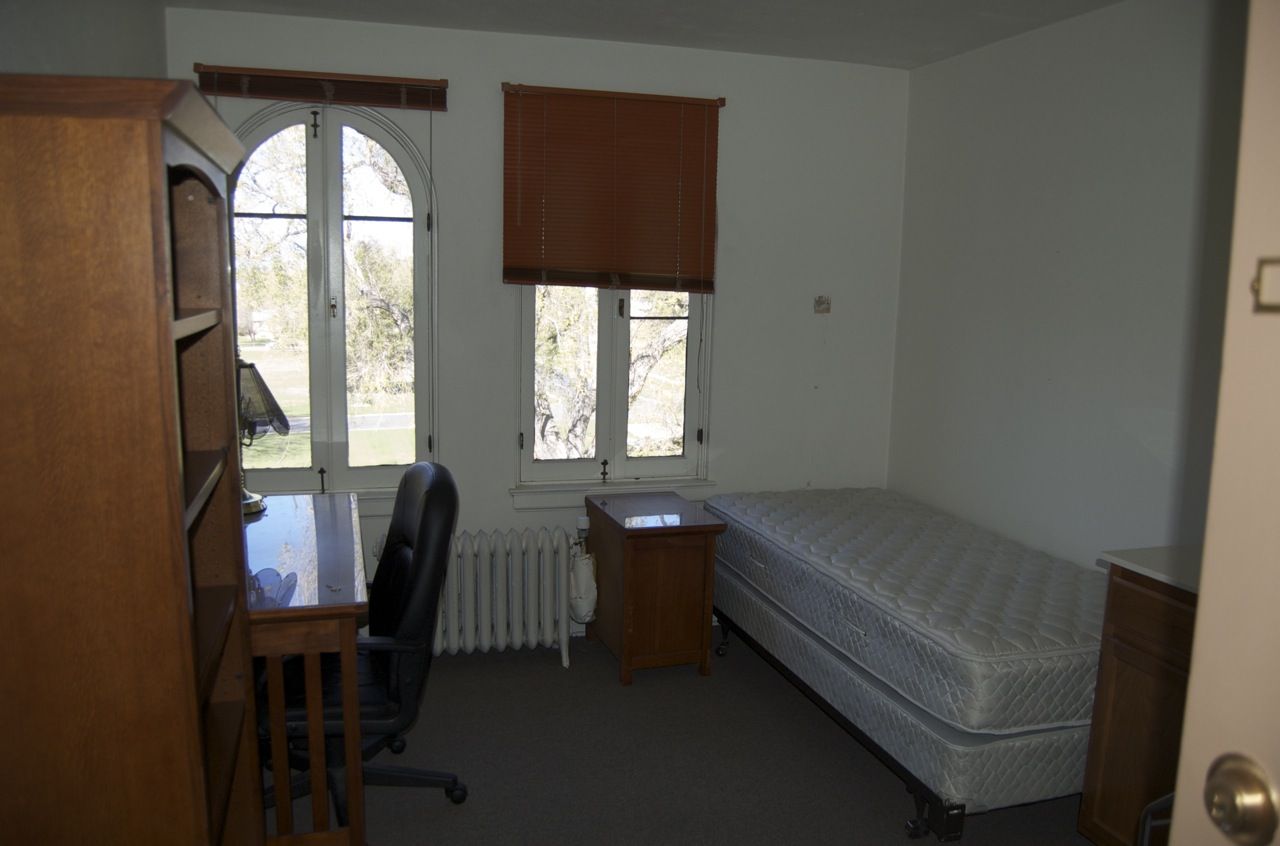 A typical room on third floor
Dominic's Nine Ways of Prayer
I wasn't too excited by this reading; it talks about the different postures in prayer that St Dominic used. Yes, we should be free to assume different postures, but I'm not that excited. Maybe I'm too much of an old fogey.
I did have a few particularly interesting notes in this lecture, though:
First a reiteration: "Scriptures are the language of prayer--we need to commit them to memory, so that they can come to our mind during prayer; if we don't commit to memory, we are impeding God's normal way of reaching us/talking to us". So again: use the one week psalter! It's a good thing.
The telos of prayer is communion/relationship with God.
And a favourite point of mine: "Reading/study is not in competition with other areas of formation: because 1) study informs your pastoral work 2) study forms good human habits 3) study leads us into deep contemplation". Needless to say, I'm excited to have a class schedule again come autumn.
I did have a few particularly interesting notes in this lecture, though:
First a reiteration: "Scriptures are the language of prayer--we need to commit them to memory, so that they can come to our mind during prayer; if we don't commit to memory, we are impeding God's normal way of reaching us/talking to us". So again: use the one week psalter! It's a good thing.
The telos of prayer is communion/relationship with God.
And a favourite point of mine: "Reading/study is not in competition with other areas of formation: because 1) study informs your pastoral work 2) study forms good human habits 3) study leads us into deep contemplation". Needless to say, I'm excited to have a class schedule again come autumn.
2010-06-27
Spirituality Year is over
I've finished Spirituality Year as St John Vianney Seminary, and my media fast is over, so I will be trying to blog about the past year in the coming months. I hope to share what I found to be particularly fruitful. Given my temperament, I'll naturally start with my handouts and notebooks from class.
My favourite class was Spiritual Classics. We spent the whole year delving into a number of the greatest works of Catholic spirituality. Our reading list was:
*Catechism of the Catholic Church (the fourth pillar thereof)
*Dominic's Nine Ways of Prayer
*Benedict's Rule
*Guigo's Ladder of Monks
*Francis Xavier Nguyen van Thuan's Testimony of Hope
*Augustine's Confessions
*Bernard of Clairvaux
*John of the Cross
*Story of a Soul, by St. Therese of Lisieux
*a retreat of Bl. Elizabeth of the Trinity
Reflections on the Catechism:
[These are disparate, and the nuggets from my notes]
Priests need to be experts in prayer for our people--they want to see someone who is deeply prayerful, who points to the Other. Every person has this desire on their heart; even if they don't want to actually turn to God, they need to see someone who is there; it becomes a matter of hope. If people can see a man who is in intimate relationship with the Other, maybe they can be in this intimate relationship with their Creator as well. I think this is why we are given the Spirituality Year, which is apparantly unique among seminaries. It's an entire year devoted to time for prayer and the spiritual life, before we're thrown into academics. The intention is that we develop a rock foundation of prayer that will sustain us throughout our life.
Prayer configures us to God the Father; it takes us into his heart.
When we pray, we come more fully what we are.
Secular priests have to be a model for everyone; we're free to borrow spirituality from all over the Church's patrimony; we must express spirituality in ways that will appeal to the lay faithful; we need to be able to relate to pretty much everyone.
One of the most important things in our life is obedience. The word comes from ob-audire: to listen. And we can't hear the Father if we don't take up our cross and follow the Son.
SY is billed as the year of the heart, because the heart is the place of encounter with God. Many of us (and me especially) are caught up in our heads and don't relate enough with our heart. SY was a great year to grow in this.
Prayer is our heart to heart relationship with God; the heart is our inner sanctuary, where God speaks to us; it is where we can talk to God.
One of the foundational virtues is humility. We each need to pray God to show me how I really am; how he sees me; to have a true vision of self. It is important to remember that God really does see each of his as his child. This is a hard lesson to learn, but important.
The spiritual life is about our thriving; God wants us to thrive, even more than we do. We thrive as we realize our identity, as sons of God; as we become more and more conformed to Christ, we become more and more who we are.
On the Holy Spirit: The Holy Spirit is the source of our spiritual life; Christ is in heaven interceding for us that we might receive him, that we will know and love him.
The Holy Spirit is the spirit of sonship; because the Spirit is in us, we are sons of the Father.
He is Jesus' Spirit, so he communicates Jesus' desires to us.
The Spirit can be deepened in us even once we have him; it's not all-or-nothing.
The reason we sin, is because be don't know God's love; we don't realize how much he loves us, and so we don't respond in love to his love.
We acquire the heart of Jesus through the Psalms. The Psalms cover the whole gamut of human emotion. The better we know them, the easier we can integrate them into our prayer life, and see them as God's words to us personally. One thing I intend to do in the coming year is to set aside one holy hour each week to memorizing psalms. I tend to waste my time in holy hours, not knowing what to do, so this will be a good way to focus myself. The importance of the Psalms is a good reason to use the Roman Breviary rather than the Liturgy of the Hours. A one week psalter can make them stick in your mind in a way that a four week psalter never will. Moreover, iyou get all the psalms, in all their parts, rather than most of the psalms, edited for content.
In my notes I have: "you begin to be able to pray continuously if you spend specific time in prayer each day". I don't exactly see this having happened in the course of the last year in my life, but I suppose I'm much better than I was last June. And the extent it hasn't happened is I'm sure some defect on my part, not having given myself well enough to the year. Pray for me.
Most Christians live their life like Michael Corleone--he always wanted to get out of the family business, but only got sucked back in each time he got close to escaping it.
We need to pay attention to the fact taht there is something in us which is repulsed by God. We must realize in our poverty taht we need God--ask God for his gift of prayer. Ask God to show us how we are (ie humility). Ask for the mercy to see how much we need him; get out from the illusion that I'm a good guy and don't kneed to be fixed; if I don't, I will inflict my wounds on my parishioners [or whoever's around me]. I can't fall into thinking I can't talk to God about my biggest problems because he'll be repulsed by them/me--he already knows, and freely chose to die an awful death so that I can be raised up from these problems and share his life. He will never refuse his mercy to we who ask for it.
And for those pursuing the married vocation: a husband's pathway to holiness is to lay down his life for his bride.
My favourite class was Spiritual Classics. We spent the whole year delving into a number of the greatest works of Catholic spirituality. Our reading list was:
*Catechism of the Catholic Church (the fourth pillar thereof)
*Dominic's Nine Ways of Prayer
*Benedict's Rule
*Guigo's Ladder of Monks
*Francis Xavier Nguyen van Thuan's Testimony of Hope
*Augustine's Confessions
*Bernard of Clairvaux
*John of the Cross
*Story of a Soul, by St. Therese of Lisieux
*a retreat of Bl. Elizabeth of the Trinity
Reflections on the Catechism:
[These are disparate, and the nuggets from my notes]
Priests need to be experts in prayer for our people--they want to see someone who is deeply prayerful, who points to the Other. Every person has this desire on their heart; even if they don't want to actually turn to God, they need to see someone who is there; it becomes a matter of hope. If people can see a man who is in intimate relationship with the Other, maybe they can be in this intimate relationship with their Creator as well. I think this is why we are given the Spirituality Year, which is apparantly unique among seminaries. It's an entire year devoted to time for prayer and the spiritual life, before we're thrown into academics. The intention is that we develop a rock foundation of prayer that will sustain us throughout our life.
Prayer configures us to God the Father; it takes us into his heart.
When we pray, we come more fully what we are.
Secular priests have to be a model for everyone; we're free to borrow spirituality from all over the Church's patrimony; we must express spirituality in ways that will appeal to the lay faithful; we need to be able to relate to pretty much everyone.
One of the most important things in our life is obedience. The word comes from ob-audire: to listen. And we can't hear the Father if we don't take up our cross and follow the Son.
SY is billed as the year of the heart, because the heart is the place of encounter with God. Many of us (and me especially) are caught up in our heads and don't relate enough with our heart. SY was a great year to grow in this.
Prayer is our heart to heart relationship with God; the heart is our inner sanctuary, where God speaks to us; it is where we can talk to God.
One of the foundational virtues is humility. We each need to pray God to show me how I really am; how he sees me; to have a true vision of self. It is important to remember that God really does see each of his as his child. This is a hard lesson to learn, but important.
The spiritual life is about our thriving; God wants us to thrive, even more than we do. We thrive as we realize our identity, as sons of God; as we become more and more conformed to Christ, we become more and more who we are.
On the Holy Spirit: The Holy Spirit is the source of our spiritual life; Christ is in heaven interceding for us that we might receive him, that we will know and love him.
The Holy Spirit is the spirit of sonship; because the Spirit is in us, we are sons of the Father.
He is Jesus' Spirit, so he communicates Jesus' desires to us.
The Spirit can be deepened in us even once we have him; it's not all-or-nothing.
The reason we sin, is because be don't know God's love; we don't realize how much he loves us, and so we don't respond in love to his love.
We acquire the heart of Jesus through the Psalms. The Psalms cover the whole gamut of human emotion. The better we know them, the easier we can integrate them into our prayer life, and see them as God's words to us personally. One thing I intend to do in the coming year is to set aside one holy hour each week to memorizing psalms. I tend to waste my time in holy hours, not knowing what to do, so this will be a good way to focus myself. The importance of the Psalms is a good reason to use the Roman Breviary rather than the Liturgy of the Hours. A one week psalter can make them stick in your mind in a way that a four week psalter never will. Moreover, iyou get all the psalms, in all their parts, rather than most of the psalms, edited for content.
In my notes I have: "you begin to be able to pray continuously if you spend specific time in prayer each day". I don't exactly see this having happened in the course of the last year in my life, but I suppose I'm much better than I was last June. And the extent it hasn't happened is I'm sure some defect on my part, not having given myself well enough to the year. Pray for me.
Most Christians live their life like Michael Corleone--he always wanted to get out of the family business, but only got sucked back in each time he got close to escaping it.
We need to pay attention to the fact taht there is something in us which is repulsed by God. We must realize in our poverty taht we need God--ask God for his gift of prayer. Ask God to show us how we are (ie humility). Ask for the mercy to see how much we need him; get out from the illusion that I'm a good guy and don't kneed to be fixed; if I don't, I will inflict my wounds on my parishioners [or whoever's around me]. I can't fall into thinking I can't talk to God about my biggest problems because he'll be repulsed by them/me--he already knows, and freely chose to die an awful death so that I can be raised up from these problems and share his life. He will never refuse his mercy to we who ask for it.
And for those pursuing the married vocation: a husband's pathway to holiness is to lay down his life for his bride.
2009-12-29
Thomas a Becket
Today is the fifth day in the Octave of Christmas, with the commemoration of Thomas Becket. Becket was Archbishop of Canterbury in the 12th century, and was martyred by the English king's (his onetime friend's) thugs for his defence of the rights of the Church. King Henry's (the second of that name) men came into his own cathedral and murdered him as he prepared for Vespers. It is a good saint story, and well portrayed by Peter O'Toole in Becket; well worth watching today if you haven't before.
Liturgically, this day is a good example of why Catholics need exposure to the Extraordinary Form. I was always puzzled by what to do with this day, and others like it. During the octave of Christmas, Lenten weekdays, and 17-24 December, memorials are outranked and thus not celebrated. The table of precedence does, however, say that "Optional memorials, as described in the instructions indicated for the Mass and office, may be observed even on" those days I just mentioned. I couldn't figure out how to do this, even though I read through the GILH every Advent, and have been saying the Office for close to three years now.
Only this year, after learning how to say the EF Office, have I figured it out. I had read GILH 239 multiple times before, but never understood what it meant. It reads:
The saints find their home in the kingdom of heaven; their life is eternal peace.
Almighty God, you granted the martyr Thomas the grace to give his life for the cause of justice. By his prayers make us willing to renounce for Christ our life in this world so that we may find it in heaven. Per DNIC...
The other Hours are normal and are not affected by the commemoration.
I hope this explains how to commemorate in the OF, so that you can now do it on the 31st for Sylvester, and during the season of Lent. Moreover, I hope it inspires you to dig into the EF for yourself.
Merry Christmas!
Liturgically, this day is a good example of why Catholics need exposure to the Extraordinary Form. I was always puzzled by what to do with this day, and others like it. During the octave of Christmas, Lenten weekdays, and 17-24 December, memorials are outranked and thus not celebrated. The table of precedence does, however, say that "Optional memorials, as described in the instructions indicated for the Mass and office, may be observed even on" those days I just mentioned. I couldn't figure out how to do this, even though I read through the GILH every Advent, and have been saying the Office for close to three years now.
Only this year, after learning how to say the EF Office, have I figured it out. I had read GILH 239 multiple times before, but never understood what it meant. It reads:
During privileged seasons, if it is desired to celebrate the office of a saint on a day assigned to his or her memorial:a. in the office of readings, after the patristic reading (with its responsory) from the Proper of Seasons, a proper reading about the saint (with its responsory) may follow, with the concluding prayer of the saint;
b. at morning prayer and evening prayer, the ending of the concluding prayer may be omitted and the saint's antiphon (from the proper or common) and prayer may be added.
That's a commemoration. The Proper of Seasons says its a commemoration. But if you haven't been exposed to the EF, you aren't going to know what the heck a commemoration is or how to do it, even with the GILH sitting right in front of you. I read that paragraph several times, understanding the words, but not knowing what they meant. Having done commemorations in the EF, the paragraph makes perfect sense to me now. But without that exposure, it was a mystery.
Commemorations are a wonderful way for the sanctoral and temporal cycles to be reconciled. Rather than one cycle being left out in the cold, with commemorations both are fit into a given celebration. It is a classic example of the Catholic preference for both/and over either/or.
So, this is how you do the Office today:
At Matins, the two readings for the proper of seasons, followed by the reading for Thomas Becket, followed by the Te Deum, followed by the collect for Thomas Becket, followed by the Benedicamus Domino.
Lauds is concluded in this way:
Pater noster...
All-powerful and unseen God the coming of your light into the world has made the darkness vanish. Teach us to proclaim the birth of your Son Jesus Christ,
Whoever hates his life in this world keeps it safe for life everlasting.
Almighty God, you granted the martyr Thomas the grace to give his life for the cause of justice. By his prayers make us willing to renounce for Christ our life in this world so that we may find it in heaven. Per DNIC...
Dominus nos benedicat....
Vespers is concluded in this way:
Pater noster...
The saints find their home in the kingdom of heaven; their life is eternal peace.
Almighty God, you granted the martyr Thomas the grace to give his life for the cause of justice. By his prayers make us willing to renounce for Christ our life in this world so that we may find it in heaven. Per DNIC...
Dominus nos benedicat....
The other Hours are normal and are not affected by the commemoration.
I hope this explains how to commemorate in the OF, so that you can now do it on the 31st for Sylvester, and during the season of Lent. Moreover, I hope it inspires you to dig into the EF for yourself.
Merry Christmas!
Subscribe to:
Posts (Atom)